With the €uro reaching 1.41$ , it’s about time to get my hands dirty and delve into a serious financial analysis of our local eco(nomic)-system. And as I’ve learned since the last days of summer, Dordogne has two currencies: mushroom and wood.
If one is the star of the season because of its scarcity, the other one rules over the surrounding hills with abundance and elegance. The rich and various colours of the forest remind me of fall in New England, or ‘England on steroids’, according to David Sedaris.
 So is Dordogneshire in a way. Full of deep red and shiny gold leaves falling on the road. The ferns, lush and proud just a month ago have opted for a chic, but sad, ‘light-brown-and-dry’ look. When the thermometer gets depressed and falls to ice-cube temperature, mornings are simply glorious. The frost over the green pasture on the hill contrasts with the vivid colours of the forest in the valley, just beautiful.
 D. the dog thinks so too, he can’t wait to run outside. Sue takes him out and D. folds his back legs to let nature take its course by the Pine-tree. Then it’s all about ‘fed up with dog poop everywhere’ and ‘why don’t you take him out’ (the latter usually coming with finger pointing). And I’m sure she is right. I should get involved in that part of the morning ritual.
But so far, from the warmth of the kitchen, gazing beyond the lime-tree, the valley looks amazing in autumn.
You would think that with so many trees around, surely, finding wood to burn should not be an issue. Ah, how mistaken you are, stranger.
Wood, like any commodity is highly dependent on time. The premise of winter in Dordogne is to wood what the Driving Season is to fuel in the U.S of A: a peak in demand reflected in rising prices that change the perception of the market.
I got my first hint at the intricacies of wood-buying after we purchased the house a little more than 2 years ago.
Christine and Guy, the parents of my friend Denis, live on the same hill than us, and they are the one who found the house for us. Retired bakers from Bergerac, they’ve done up their house here for the last three decades. It’s now an enchanting stone building with a nice swimming-pool and some super-classy flats to rent in the tobacco barn.
We visited them for lunch, after we bought the house, during Christmas vacations, over a year ago.
Pointing at the neat pile of logs, under the trees, I asked :
-Guy, how would one go about buying some logs ‘round here ?
-You buy wood in summer, he replied.
His eyes told me that my question was border-line heretic. Asking about the purchase of logs in wintertime was like claiming to holiday in France without swallowing any meat, cheese, garlic or wine, pure blaspheme.
I dropped the topic and debated the issue with Sue. She is way more pragmatic than I am. Thus, she pointed at all the posts and derelict pieces of fence that populated our ten acres and suggested we’d burn that instead. We picked up and gathered, with the merry help of our families, assembled and stacked, but never reached the beautiful symmetry of a well-organised woodpile.
By that time, we had met Paul (the episode of impromptu drink under stuffed-deer-head in sweaty armpits with fluorescent T-shirt would come months later).
We had introduced ourselves as we walked up the hill past his house, exchanged a few words over the fence, patted his dog on the head. Just enough civilities for Sue to ask him one day:
-Paul, how would one go about buying some logs ‘round here ?
-You can’t buy wood, he replied.
This was winter remember, and she knew she was already treading on very thin ice, but she had a plan, trying to play the genuine naïve which has been my strategy since I’ve set foot here.
-Oh yeah, it’s true, you buy wood in summer.
-No, YOU can’t buy wood. (long silence) Look at how many trees you have ! Before buying wood, you need to chop a few trees down and split them into logs.
So, that’s what we have done. My parents have bought us a nice chainsaw, as a Xmas present and I’ve been playing lumberjack since, under Paul’s supervision.
He’s told me off for not sharpening the teeth on the chain properly, took it away to its den to bring it up to amateur-tree-chopper standard and told me off the second time I got it out, for not sharpening it properly. Surely, he had forgotten he’d taken care of it himself but I got his point: someone knows more about chainsaws than I do and that’s him.
A few weeks ago, as I proceeded to cut logs from the tree he had taken down for me (“you should wait another month, then you wouldn’t have so many leaves, he specified AFTER he’d cut it”), he joined in with his better-cutting chainsaw, a rolled up cigarette in his mouth, and chopped away as if he was scooping half-melted ice-cream. I was sweating like a maniac in my polyester jacket and finally needed his help to unblock the chainsaw from the stump.
It’s a long road to become a lumberjack. But hey, I’ve got a cool checkered shirt now and thanks to Paul (thank you, thank you), logs to pile.
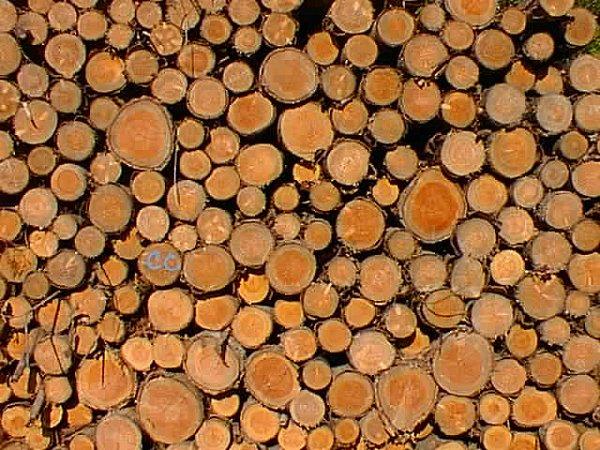
But not everybody owns trees to chop, or has a helpful neighbour to guide them.
Those poor souls, therefore, are bound to fend for themselves in the mercantile jungle of Dordogne-wood-merchants.
Some friends tried to improvise once by stopping in a farmyard, literally surrounded by dozens of meters of wood-piles and asked if they could buy some.
The answer they received from the farmer was pure French-spirit in a bottle:
-What wood? We have no wood.
Not: ‘Sorry, we can’t sell you any, we’re going to burn those 15 tons of woods in our little house over the next 4 months, because we live naked and cook on radiators and if they’re some left I d rather eat it than selling it to you!’ No, just pure denial.
Maybe it never crossed his mind that he could sell it…oh, I love him, even from my desk I can see him shrug as he says: ‘Nope, we have no wood’.
I guess having a whole meter deep wall of logs by your house is like owning a gun in the US: comfort by its presence without planning to use it (at) all. And even if you’d use up all your wood, you could actually buy some (in the summer) or pay through the nose in autumn.
But how much wood does one need? Excellent question, I have no idea of the answer because I can’t understand it.
-Wood comes in ‘brasse(s)’ told me Jean-Paul, the retired farmer, it’s nearly 4 ‘stere(s)’ [pronounced liked ‘stair’ as in stairway].
Since, I have learned that‘Stere’ is a measurement specific to wood and equals to 1 cubic meter. Brasse is actually 5 feet x 5 feet x 5 feet, or 1.6 m x 1.6m x 1.6 m so basically 4 cubic meters. Click here if you enjoy this.
I’m not an advocate of standardization and I like to find out a unit that only applies to one specific object. But I’m also reassured to know that things got a little easier to understand lately. Look at this: a few centuries back Brive and Tule who are at least 40km apart had different sizes for 1 Brasse (2.329 in Brive/ 2.14 in Tulle).
That’s why that French farmer pretended he had no wood for my friends. He couldn’t figure out if, with their English accent, they were more accustomed to the Brasse from Brive or the Brasse from Tulle.
If you persist, and really plan to buy logs down this part of the country, you have to count close to 50€ for a stere of oak tree, which is at current rate what you’d pay for 2 kilograms of Cêpes.

Why! Didn’t you know, prices have gone through the roof this year. The lack of rain in September-october, the frosty nights, it has all combined to an extremely poor mushroom season.
Sue and I have found some Cêpes-looking-like-‘shrooms but a quick cut in the flesh and we knew those were the wrong kind.
-If they go blue immediately, they are no Cêpes, once stated Jean-Paul, they wouldn’t kill you but if you ate them you’d get the runs.
Saddle with such unexpected knowledge we are therefore biting our nails in anticipation for the day when we’ll come across a real Cêpe, and cook it in an omelette. For now, it’s all window licking at Bergerac’s market, staring in passing at those overpriced fungi from Correze, the neighbouring area.
-Don’t be sad told me Pierrette, Jean-Paul’s wife, those mushrooms from Correze (Brive and Tulle are the main towns of Correze) are not half as good as our Cêpes! They’re not the real deal!
I’m with her on this. Nothing from Correze can be trusted. I mean, come on! Those guys had two different unit of measurements for cubic meters of wood 2 centuries ago! That's a sign.


No comments:
Post a Comment